
Chapter 1: Editing and Proofreading

Welcome to Broke Author!
Come along with me as I revise and post an updated edition of my book, Self-Publishing for the Broke Author, one chapter at a time. You’ll also find extra advice on editing, book design and production, self-publishing and book marketing, with a view towards getting it all done without going broke.
Click here for the Introduction.
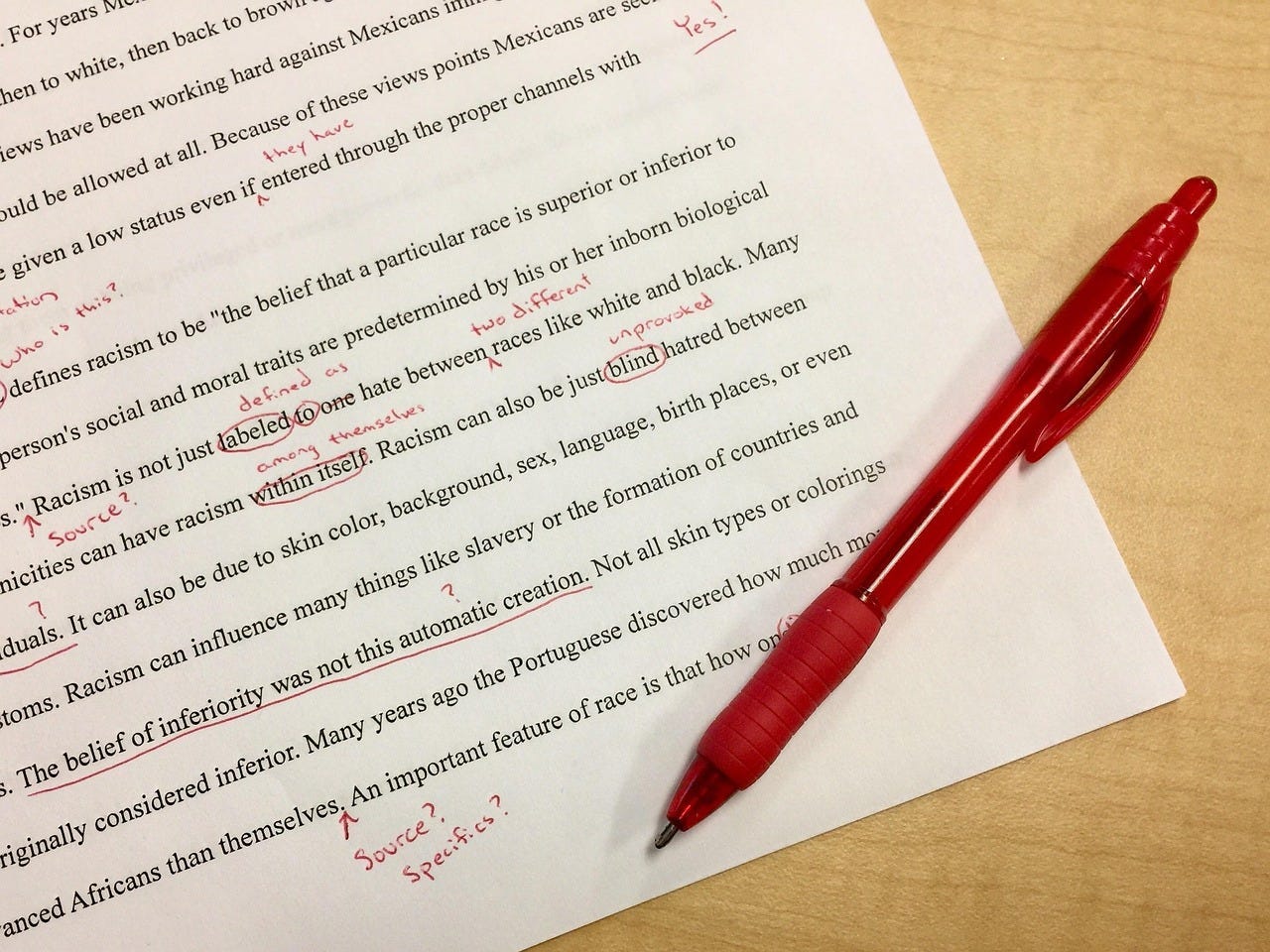
Is editing important? In the first edition of this book, I said that I couldn’t stress enough the importance of a good edit. And then I went on to watch an entire self-publishing paradigm emerge in which high-output authors went on to make high five- and even six-figure careers for themselves by churning out anywhere from one to four books a month for their Kindle Unlimited fans. Books that were formulaic, written to market and, in most cases, barely edited at all.
It was a gold rush of rush-to-publish in high selling genre niches, one in which I couldn’t possibly keep up. But as I sat back and observed, a few things became evident. A lot of those books and series had flashy (and costly) ad campaigns and lots of sales and KU reads, but poor reviews. So even as it seemed like there was a market — and a lucrative one, at that — for poorly edited books as long as they’re entertaining, the reviews said otherwise, with bad or no editing being a common reader complaint. It became clear that poor editing was seen as a hallmark of self-publishing, and it was giving all self-published books and authors a bad rap.
Of course, another pitfall was that those authors quickly burned out and left their fans hanging (and angry) when they couldn’t bring themselves to write anymore and needed to take a break.
The high-output fast publishing boom became a bust, and a lot of really tired authors learned that get-rich-quick publishing schemes that rely on shortcutting on quality aren’t sustainable, and they’re not what most readers want. Readers firstly want to be entertained, or educated, or to be fed food for thought. But they don’t want to be pulled out of the story by clunky or wooden dialogue, enormous plot holes, continuity errors, or multiple glaring typos and punctuation errors.
This is not a book about how to publish fast and get rich. This is about how to produce both physical and electronic books that, at least in terms of production quality, can compete with Big Publishing without going broke. And if that’s your goal, then your book needs to be edited.
If you want to be the kind of author who consistently gets positive reviews and has a devoted readership who is happy to evangelize about your books to others, then don’t skip or skimp on the editing process. And if you have any money to spend on book production, this is where I most recommend you spend it.
Does this mean you have to lay out a lot of money to hire a professional editor? No, it does not. But before I get into the budget-friendly options, let’s first talk about the stages and types of editing.
Stages of Revision
Ideally, a manuscript will go through several stages before it’s ready to be published. The first, of course, is the drafting stage, wherein the book actually gets written. No duh, right? Let’s move on.
The second stage usually encompasses your own revisions. This is the part where you read through what you’ve written — preferably after you’ve had enough of a break from looking at it and thinking about it that you’re seeing it with at least semi-fresh eyes — and fix the problems that you yourself are capable of spotting and identifying, revising, rewriting and polishing your prose as you go. By the end of this stage, you’ll have what amounts to your second draft. Simple enough.
Now this is where it can get tricky. Do you send your second draft to an editor, or do you send it to beta readers first? Or do you show it to a trusted first reader and complete a third draft based on their feedback before showing it to anyone else? Depending on how much time you have and on the budget editing strategy you settle on, there could be any number of additional passes at this stage. Let’s say, at a minimum, you want to have beta readers look it over before you send it to an editor.
Why not just send it to the editor first and let them fix everything? Because regardless of whether you are paying cash money for a professional editor’s services or you’ve convinced your high school English teacher to look it over in exchange for helping her grade essays, your editor will be able to do a better job if you have already cleaned up your manuscript as much as possible on your own. Speaking as someone who has done her fair share of freelance editing, I can promise you that an editor is better able to focus on what can improve your story and the overall quality of your prose when she’s not bogged down in correcting grammar, punctuation and sentence structure.
Also, contrary to popular belief, it’s not actually an editor’s job to fix your book. It’s an editor’s job to point out problems and, when appropriate, offer suggestions. It’s still your job to fix said problems. Exactly how much hands-on revising an editor does depends on the type of edit she’s been hired to do, which we’ll get into in the next section.
But the point is, between the second draft and final pass of your manuscript, you want to have eyes that are not yours on your manuscript and gather feedback — all of which leads to the final stage: proofreading, which should be the absolutely last pass of your manuscript, after all other revisions have been done.
Why? Because every new revision and editing pass creates opportunities to introduce new errors and typos. The final proofreading pass is for the purpose of hunting down and zapping these errors out of existence, as much as humanly — or, nowadays, perhaps non-humanly — possible.
Types of Editing
A lot of writers aren’t aware that there are different types of editing, each of which serves a different purpose. Let me break them down for you.
Developmental Editing - Also known as substantive editing or structural editing, this type of editing is typically done fairly early on, usually when an author feels stuck or knows there are issues that they can’t quite put their finger on or see a way to fix. It looks for potential problems with the story itself: pacing, plot holes, inconsistencies, lack of character development, scenes that put the reader to sleep, that sort of thing. A lot of these problems can be identified and worked out with a good team of beta readers; but if you feel like you need professional help to get yourself out of a hole, this is a good type of editing to invest in, if you can.
This type of edit can range from a critical analysis of your manuscript, in which the editor simply makes suggestions and leaves it up to you to make the changes; to hands-on editing that rips out the parts that aren’t working, rearranges scenes or sections for better flow and also offers suggestions that you, the author, can choose to implement. Obviously, the more hands-on an editor is with your book, the more it’s going to cost you.Copy Editing - Also known as line editing, this type of edit looks at the writing mechanics: sentence structure, awkward phrasing, dialogue that’s not working, grammar and syntax issues, placing your commas correctly, etc. This is probably the most common type of edit that gets hire out to professionals, as it’s what most people think of when they think of editing.
If you invest in this type of edit, look for an editor who is willing to provide a sample edit and make sure they will actually improve your writing and not simply stomp all over your voice and style. Ideally, a professional editor will simply point out things that need to be fixed and, although they may offer suggestions, ultimately they’ll leave how to fix it up to you. But again, the more you can address these things yourself before sending it to an editor, the less a professional edit will cost you.Proofreading - This type of edit searches your manuscript with a fine tooth comb to spot and correct errors of spelling, typing, punctuation, grammar, syntax, formatting, etc. As mentioned previously, this should be the absolute final edit, and it should be done by someone other than yourself, and it should involve more than simply running a spell and grammar check.
How much can you expect to pay for these types of edits? It will largely depend on the type of edit you’re getting, the size of your manuscript, the quality of your writing to begin with, and the experience and reputation of the editor. In general, for a full-sized novel or non-fiction book, you can expect to spend anywhere from several hundred to several thousand dollars.
Of course, if you’re reading this book, that’s very likely an unrealistic proposition. Before we move on, I should point out that many freelance editors will let you pay in installments, and some even offer financing. However, I don’t recommend or advocate that you go into debt in order to get your book edited. The sad reality is that, unless lightning strikes and you turn out to be the next E.L. James or Hugh Howey, you won’t make your money back — at least not for a long time.
So where does that leave you? Fortunately, with a few options — moreso than when I wrote the first edition of Broke Author, long before AI came on the scene.
Here is my disclaimer that my job here is to explain your options and tell you how to produce your book with the available tools and resources. It’s not my job to tell you how you should feel about those options, or pontificate on how I feel about them.
Editing on a Budget
Whether you’ve got a little money to invest in editing, or you’re working with no money at all, don’t fret. Editing is not an all-or-nothing proposition.
If You Have a Little Money...
Ask for a professional critique, which typically costs substantially less than an edit. If you can afford to send in the entire manuscript, great, but if not, most editors will be happy to critique a few chapters or even a few problematic pages. I’ve worked with critique clients that have sent me one or two chapters at a time, as they could afford it, which I critiqued and provided feedback as we went. It took over a year at that rate, but we got through their entire novel, and it was much better for the time and effort spent.
Ask for a partial edit. Again, most freelance editors will be happy to edit a single chapter or even a few pages. Send in the roughest or most problematic section of your manuscript and request a line edit. You can then use that edit as a guide as you self-edit the rest of your book. Or, as in the example above, keep going back for partial edits as your budget allows until the entire book is done.
Give a new editor a chance. Someone who is just starting out and trying to establish an editing business, who doesn’t yet have a body of work or experience in this field, will likely charge much less than an established editor. Depending on how eager they are to build their portfolio, they might even be willing to work for free in exchange for a testimonial or referrals — but you shouldn’t approach them with this expectation. At the very least, offer to pay what you can.
Try Fiverr. Fiverr is a freelance marketplace that got its name from the initial idea that freelancers would provide their services starting at only five dollars. The site has grown up quite a bit since then, and while you can expect most service providers to charge substantially more than a fiver for their work, you can find a wide range of services and experience levels that make it fairly easy to find editing and other publishing-related services that fit your budget.
Invest in ProWritingAid, an AI-driven app that bills itself as a “grammar guru, style editor, and writing mentor in one package.” While it’s always preferable to have actual human eyes check your work, an AI editor might be the next best thing, and this one can do many of the same things a human editor could do for you. They have a free version, which I’ve used to help self-edit a few of my own books, but it’s even more limited now than it was when I used it. My only caution is the same is it would be for working with a human editor — editing suggestions are only that. Feel free to ignore them if you don’t agree with them.
Save your money for the proofreader. If you feel confident that you’re able to work out story issues with the help of trusted beta readers and polish your prose to a level that leaves both you and your readers satisfied, then you’re better off hiring a proofreader anyway. And proofreading typically costs quite a bit less than substantive or line editing.
If You Have No Money...
Join a writing or critique group. Whether you meet with one in person or online, a writing group can provide valuable feedback on your manuscript. While it won’t cost you any money, it will cost quite a bit in time, as you’ll be obligated to return the favor by reading and providing feedback on the other members’ work.
Assemble a team of trusted beta readers. Look for people who not only have a good grasp of grammar and sentence structure, but who are well-read and familiar with the genre in which you’re writing. Be sure to recognize that they’re giving up their valuable time to do you a favor, even if they seem excited to read your book. Provide them with deadlines, but don’t hound them or guilt them if they’re not able to deliver. And be sure to compensate them in some way, whether that’s thanking them by name in the book’s acknowledgments, providing them with free copies of the final book, or baking them cookies to show your appreciation.
Barter or trade for editing services. Do you have editing skills and know another writer who does editing on the side (or vice versa)? Offer to swap manuscripts—you’ll edit hers if she’ll edit yours. But editing isn’t the only thing you can trade. Can you help a freelance editor improve her website or beef up her SEO? Can you write some articles for her blog? Is there someone local to you for whom you could provide a more hands-on service such as yard work, house cleaning or babysitting? See also my previous example of helping your old English teacher grade papers. Get creative. There are a lot of different ways to “pay” for editing services that don’t involve money.
Use Grammarly, a free online AI app that can check your writing for spelling and grammar errors, passive voice and misused words as you go. There’s also the free version of ProWritingAid that I mentioned above.
Use ChatGPT for substantive editing. While I haven’t done this myself, I’ve seen examples of ChatGPT and other Language Learning Models (LLMs) providing manuscript critiques and analyses along with helpful feedback. If you’re truly broke, then this could be a helpful resource.
As you can see, not having a budget set aside to hire an editor is not the end of the world, nor is it the end of your self-publishing ambitions. With a combination of creativity, time and sweat equity, there are plenty of other paths you can take to achieve a polished, publishable book.
Your Strategy
Take time to answer the questions at the end of each chapter to help you develop your budget publishing strategy. You can either grab a notebook and write them down, or head here to download a free set of worksheets.
1. What my manuscript needs the most help with is _____.
2. Who do I know who would make a good beta reader?
3. For each person listed above, list their strengths (I.e., good grasp of grammar, eagle-eyed typo spotter, good understanding of story structure, pacing, etc., good knowledge of my genre).
4. How much money, if any, could I allocate to editing?
5. Which type of edit would give me the most bang for my buck?
6. Who in my network has editing skills and might be willing to barter with me?
7. What skills or abilities do I have to barter with?
Thanks for reading! And if you’re in need of a budget-friendly editor, look no further. I offer editing and proofreading services at affordable rates and I’m happy to do partial critiques and edits and work with you at a pace that suits your available budget.
Have your own tips for low- or no-cost ways to get your book edited? Share them in the comments.
If you enjoyed this free post or found it helpful, a like, comment, restack or share will go a long way towards boosting its visibility for others to find, as well as keeping the author motivated. And if you’re not actually broke, you could also consider buying me a coffee.
And don’t forget to check out my fiction!